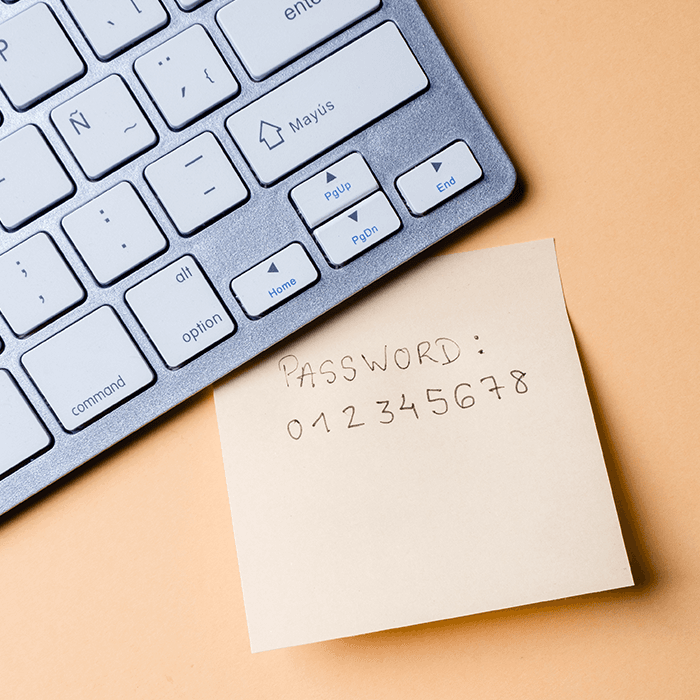

Imagine someone trying every possible key combination on your office door until one finally works. Brute force attacks operate on the same principle, systematically testing thousands of password combinations to break into your accounts and systems.
These attacks remain alarmingly effective against weak passwords. Understanding how they work is critical for protecting your business data and systems.
What is a brute force attack?
A brute force attack is a cyber attack method where criminals systematically try every possible password or key combination until they find the correct one. This trial-and-error approach targets the weakest link in many security systems: password strength.
Modern computing power makes these attacks faster and more dangerous than ever. What seemed like a strong password years ago might now be cracked in hours or days.
Criminals may start from a known compromised password and try similar ones. People tend to reuse passwords across accounts and systems, either directly or with minor variations. This makes brute force attacks easy for cybercriminals.
Types of brute force attacks
- Simple brute force attacks test every possible character combination. Effective against short passwords, this method becomes impractical as password length increases.
- Dictionary attacks use precompiled lists of commonly used words. Attackers exploit people’s tendency to choose familiar words or patterns for their credentials.
- Hybrid attacks combine dictionary and brute force methods. Attackers start with common words, then add variations like numbers or symbols. For example, password123! combines a common word with a popular suffix.
- Credential tweaking tries variations of a compromised password against that same user on other platforms. The attackers try to exploit the fact that people often use passwords that are similar (though not identical) across sites and accounts. For example, if the password Sarah2019! is breached from site A, attackers try Sarah2020!, Sarah2021!, Sarah@2019, and so on, on site B. This method has a greater likelihood of success.
How brute force attacks work
Brute force software runs continuously and can test millions of possibilities in a short time.
Online attacks target live systems like website logins, where account lockouts can slow down attackers. Offline attacks occur when attackers obtain encrypted data copies and crack passwords without triggering security alerts.
Attack motivations and tools
Criminals use brute force attacks for various purposes. These can include financial gain, stealing data or business information, or industrial espionage.
Popular attack tools include Hydra, John the Ripper, and Hashcat. These tools automate password guessing and customize attack methods for greater efficiency.
Recent trends show that attackers using cloud computing and distributed networks to multiply attack speed. AI-driven algorithms are making attacks more adaptive and persistent.
Prevention strategies for businesses
- Account lockout policies automatically lock accounts after failed login attempts. This simple measure dramatically reduces the effectiveness of brute force attacks.
- CAPTCHA systems block automated scripts by requiring users to complete visual puzzles. This limits the speed and scale of automated attacks.
- Strong password requirements should mandate complex passwords mixing uppercase letters, lowercase letters, numbers, and symbols. Monitor for password reuse across systems, which amplifies damage when credentials are compromised.
- Multi-factor authentication adds verification steps like text message codes or authentication apps. This significantly reduces unauthorized access risk, even with compromised passwords.
- Regular security audits help you to identify vulnerabilities and keep your defenses current against evolving attack techniques.
- Encryption keys protect sensitive data from brute force attacks. For most applications, 128-bit encryption offers strong protection. Financial institutions and government agencies often go further and use 256-bit encryption, which takes even modern supercomputers a long time to crack. However, even strong encryption is vulnerable if the passwords protecting access to encrypted systems are compromised.
- Credential monitoring solutions, such as Cybercheck, detect exposed passwords before attackers can exploit them. Cybercheck scans criminal forums and marketplaces for compromised credentials, alerting you immediately if criminals are trading information about your organization. That means you can change your passwords and shut out potential attackers, before they use them to access your accounts and make you their next victim.